





Fire risk in high-rise and super high-rise buildings DG 533
BRE (Building Research Establishment) is an independent, research-based consultancy, testing and training organisation, operating in the built environment and associated industries.
Ensuring high-rise buildings are safe presents a number of challenges. For example, there is no standard definition of what a high-rise building is. Traditionally, in the context of fire, high-rise buildings have been considered to be buildings high enough that a fire cannot be fought using standard firefighting methods. As a result, there are significant differences to the fire safety measures required in high-rise buildings. These related to; the number of occupants high above the ground, the possible adoption of a phased evacuation strategy or a ‘defend in place’ strategy, the length of time needed to evacuate and so on.
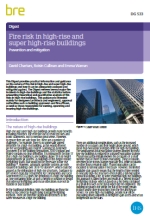
Fire risk in high-rise and super high-rise buildings: Prevention and mitigation (DG 533) was written by David Charters, Roisin Cullinan and Emma Warren, and published by BRE on 21 August 2014.
The 12-page digest provides guidance about the nature of fire risk in high-rise and super high-rise buildings and how it can assessed and mitigated. It reviews a number of fires in high-rise buildings and presents theoretical and quantitative analysis of fire risks.
The digest is intended for designers (such as architects and engineers), approval authorities (such as building control bodies and fire officers), as well as the owners, operators and insurers of high-rise buildings.
The contents of the digest include:
- Introduction.
- The nature of high-rise buildings.
- Existing guidance for fire safety in high-rise buildings.
- Fire events in high-rise buildings.
- Examples of high-rise building fire events.
- One Meridian Plaza, Philadelphia, 1991.
- World Trade Center, New York, 2001.
- Cook County Administration Building, Chicago, 2003.
- Windsor Tower Fire, Madrid, 2005.
- Analysis of fire risks in high-rise buildings.
- Risk as a function of the height of a building.
- Analysis of fire statistics.
- Computer model for fire risk in high-rise buildings.
- Results of analysis.
- Findings and conclusions.
- References.
[edit] Related articles on Designing Buildings
- Addressing building failures: Grenfell Tower and Edinburgh schools.
- Automatic fire sprinkler systems: A good practice guide.
- BRE articles on Designing Buildings Wiki.
- BRE Buzz articles on Designing Buildings Wiki.
- BRE Buzz.
- Building Research Establishment.
- Buildings of a great height IGH.
- Buildings of a very great height ITGH.
- EWS1 forms not required for buildings without cladding.
- Fire in buildings.
- Fire protection engineering.
- Fire safety design.
- Grenfell Tower fire.
- High-rise building.
- Managing fire risk in commercial buildings: A guide for facilities managers.
- Megastructure.
- Megatall.
- Scottish Advice Note addresses fire risk in multi-storey residential buildings.
- Specify with caution to new BS 8579:2020.
- Sprinkler.
- Super-slender.
- Supertall.
- Tallest buildings in the world.
Featured articles
Check out some of the best features and news from Designing Buildings as well as key stories from around the web.

Government approach could undermine delivery and regeneration.
World's first mass timber data centre.

The overlooked environmental aspect of data centre development.
Introduction to radon awareness

New technical information sheet published by CIOB.

Updated supplier guide can help electrical contractors engage with NHP.

CIAT confirm the winners of the 2026 architectural technology awards.

Government launches a one stop shop for flood preparedness.

Sir Edwin Lutyens: Britain's greatest architect? Book review.

CIOB publishes free template to help assess and manage risks.
ECA's reflections on Party Conference season

Burnham wants to be confident of winning before asking for a fresh mandate.
New Chief Construction and Scientific Adviser

Sergio Cavalaro, Professor of Infrastructure Systems at Loughborough University.
Building safety levy for England

CIAT publish estimator tool for members.

Water sector faces a growing crisis that could slow the delivery of vital infrastructure.